


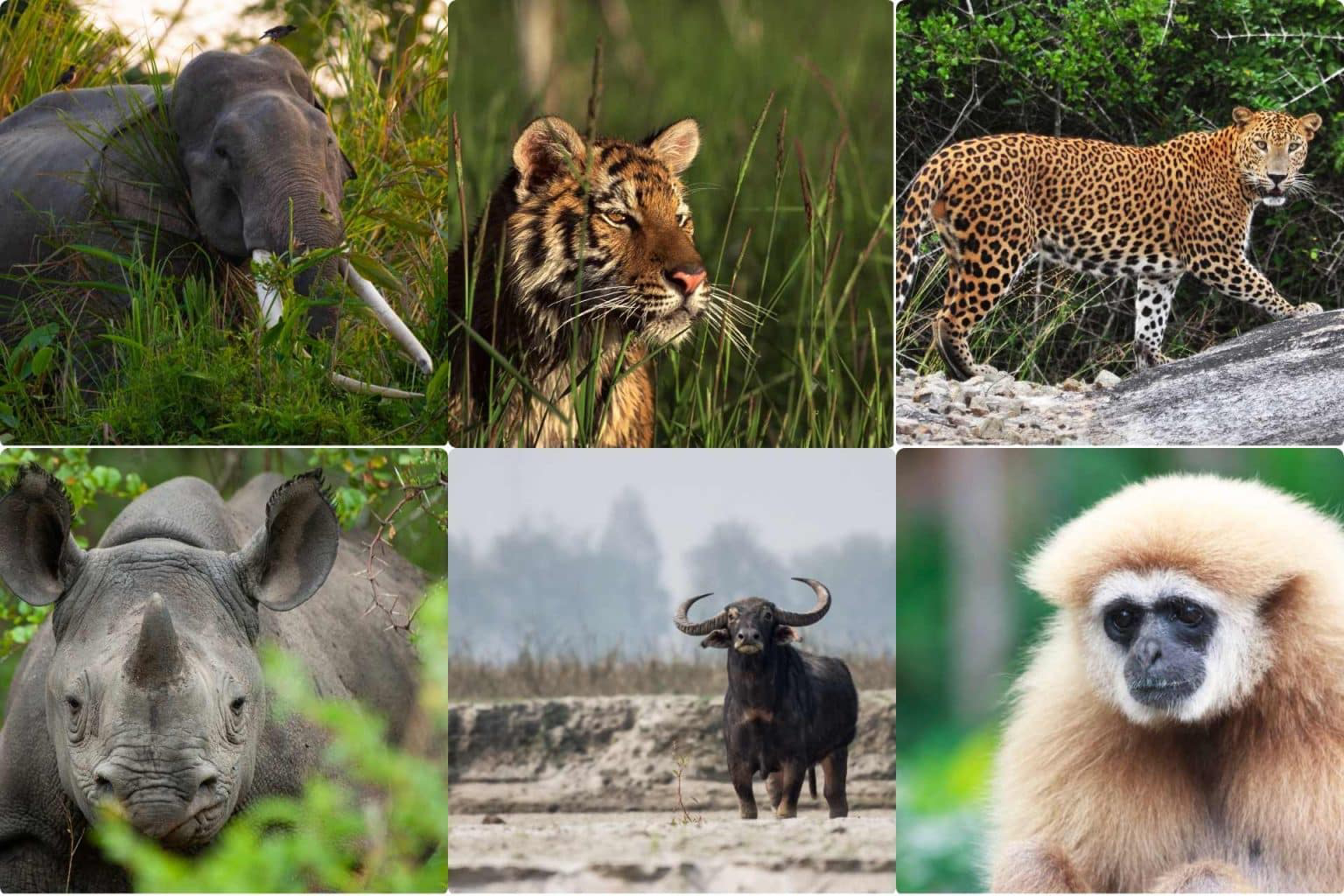
top indian wildlife species you can spot across the country
- Travel
India Has 7% of All Species on Earth. Most Wildlife Tourists See About Four of Them.
The tiger gets all the press. Ranthambore, Corbett, Bandhavgarh, same three parks, same animal, same photograph on the same travel lists every single year. The tiger is extraordinary. Nobody is disputing that.
But Indian wildlife species run to somewhere between 91,000 and 100,000 documented varieties depending on which taxonomy you're using. The mainstream wildlife circuit covers maybe a dozen of them. The rest exist in landscapes that most visitors fly over on the way to the obvious destinations, never knowing what's below.
One-horned rhinos in Assam. Gharials in the Chambal. Snow leopards in Ladakh. Greater adjutant storks on Brahmaputra sandbanks, critically endangered, one of the largest flying birds alive, and almost entirely absent from Indian wildlife travel conversation. Nilgiri tahrs on Western Ghats ridgelines. Smooth-coated otters in rivers that still run clean. Red pandas in Sikkim forests. Irrawaddy dolphins in Chilika.
All of this is India. None of it appears on the standard itinerary.
Assam First. Always Assam.
Kaziranga gets a fraction of the tourist footfall that Ranthambore receives. That gap in attention is genuinely difficult to explain once the numbers are understood.
2,600 one-horned rhinos. That's not a park statistic, that's 70% of the entire global population living in one floodplain in Assam. Wild water buffalo moving in herds that make a jeep feel irrelevant by comparison. Swamp deer. Tigers hunting in open grassland rather than the dense forest most people associate with them. A bird list that runs past 480 species, which is more than most European countries hold in total.
Then the river.
The Brahmaputra flows along Kaziranga’s northern edge, shaping a landscape that feels entirely separate from the park’s core zones. As winter sets in and water levels recede, sandbanks emerge mid-river, prime gathering grounds for the greater adjutant stork, a species with only a few hundred individuals left globally, seen here in notable numbers at the right time and place. In the deeper channels, Gangetic river dolphins surface, while along the fringes, fishing cats move quietly in the early hours before sunrise.
No jeep trail leads to a mid-river sandbank, and that’s precisely the point.
The Ecosystems Most People Drive Past
India's forests, grasslands, wetlands, and river systems each hold their own species assemblage, distinct enough that a naturalist from the Western Ghats and a naturalist from the Terai are essentially working in different countries.
The Terai grasslands along the Nepal border support barasingha, the swamp deer whose last meaningful Indian population is here, grazing in tall grass alongside rhinos and tiger prey species that make Dudhwa worth the journey even though almost nobody makes it.
Central India's sal forests, Kanha, Pench, Bandhavgarh, are where the tiger density is highest and where dholes, the Indian wild dog, hunt in packs that cover ground with an efficiency that's uncomfortable to watch. Sloth bears blundering through undergrowth. Gaur standing nearly six feet at the shoulder in forest clearings, enormous and completely unbothered.
Western Ghats:
One of twelve biodiversity hotspots on earth. Lion-tailed macaques in the Anamalai hills, black-maned, silver-faced, sitting in the canopy of a rainforest that has been continuous since before India separated from Gondwana. Malabar giant squirrels the size of a small cat, coloured in deep maroon and cream, moving through the high canopy faster than the binoculars can follow. King cobras in the valley forests. Nilgiri tahrs on the upper grassland edges.
The Sundarbans:
Tidal forest, brackish water, the only tiger population on earth that hunts in saltwater channels and swims between islands. Estuarine crocodiles. Irrawaddy dolphins in the river mouths. Olive ridley turtles on the coastal fringes.
Four ecosystems. None of them the same. All of them India.
The River Species Nobody Is Looking For
Freshwater and riverine Indian wildlife species are the category wildlife tourism consistently fails to serve.
Gharials in the Chambal, the long-snouted fish-eating crocodilian that went functionally extinct in most of its original range and is clawing back a population in the Chambal's protected waters. Smooth-coated otters in river systems across peninsular India, visible in the early morning in the waterways that still run clean enough to support them. Gangetic river dolphins navigating by echolocation in turbid water, surfacing in river stretches where the development pressure hasn't yet won.
The greater adjutant stork again, because it deserves the second mention. A few hundred individuals globally. The Indian population concentrated around the Brahmaputra wetlands. Standing over a metre tall, bald-headed, slightly prehistoric in appearance. The kind of bird that stops experienced birders mid-sentence because the size and the rarity arrive simultaneously and neither quite seems real.
The Operator That Chose the Rivers
There are wildlife operators and then there are operators who chose specific ecosystems, learned them deeply, and built everything around that knowledge. Adventure Resorts & Cruises Pvt. Ltd. falls into the second category.
Two different rivers. That's the entire geographic focus. The Brahmaputra in Assam and the backwater network in Kerala. Not a pan-India catalogue. Not twenty destinations covered by a generalised team. Two waterways, studied across seasons, with guides who know the patterns the way guides only know things after years of watching the same water from the same vessel.
M.V. Mahabaahu on the Brahmaputra moves through the exact habitat where the greater adjutants gather, where the dolphins surface, where the Kaziranga grasslands meet the river's floodplain. The upper deck is a working wildlife platform, stable enough for serious optical equipment, positioned to use the river's silence rather than fight it. Morning sandbank positioning is itinerary, not bonus. Kaziranga jeep safaris for the park zones are coordinated directly off the vessel, which means the Brahmaputra ecosystem, river and grassland both, gets covered from a single base without the logistics competing with the observation.
M.V. Vaikundam on Kerala's backwaters works a different set of indian wildlife species entirely. Waterbirds in the paddy margins. Kingfishers on canal stakes. The backwater ecosystem as an inhabited landscape rather than a scenic backdrop.
Cabins aboard the M.V. Mahabaahu range from Superior to Suite, complemented by a spa, curated cultural programming, and refined dining. The comfort is intentional, it allows you to focus entirely on wildlife observation, without the distraction of managing the basics.
From October through March, the Brahmaputra shows its most accessible side. Water levels drop, sandbanks emerge, migratory birds arrive, and wildlife becomes visible in ways the monsoon season simply doesn’t permit.
Last Thought
Indian wildlife species are not a list to be photographed at a series of designated parks. They're the product of ecosystems that developed across millions of years in landscapes ranging from Himalayan river valleys to coastal mangroves to high-altitude grasslands to peninsular rainforests.
The tiger is real and worth finding. So is the greater adjutant on a Brahmaputra sandbank before the rest of the river wakes up. So is the gharial in the Chambal, the lion-tailed macaque in the Western Ghats, the Gangetic dolphin in a river that still holds it.
India's wildlife is the argument for spending more time in the country than the standard circuit allows. The standard circuit hasn't scratched it.